Annapurna Region Permits and Cost Guide
The Annapurna region in Nepal is considered one of the most diverse and popular trekking destinations in the world. When it comes to permits, the Annapurna region has the simplest form of permit system. Since the Annapurna region circles around the Annapurna Massif, the region offers ample trekking destination options. The popularity of Annapurna Region Trekking cannot be compared to other one-way destinations.
Whether you are trekking to the popular Annapurna Base Camp, doing the iconic Annapurna Circuit, trekking to the newly opened Mardi Himal, or hiking the short Poon Hill Trek, there is only one permit that matters, and that is:
- The ACAP (Annapurna Conservation Area Project Permit)
Unlike the Everest region, the Annapurna region is more confined to the Annapurna Conservation Fees. Here is the simplest guide to Annapurna region permits, their costs, where you can obtain them, and other guidelines.
The One Mandatory Permit You Actually Need: ACAP
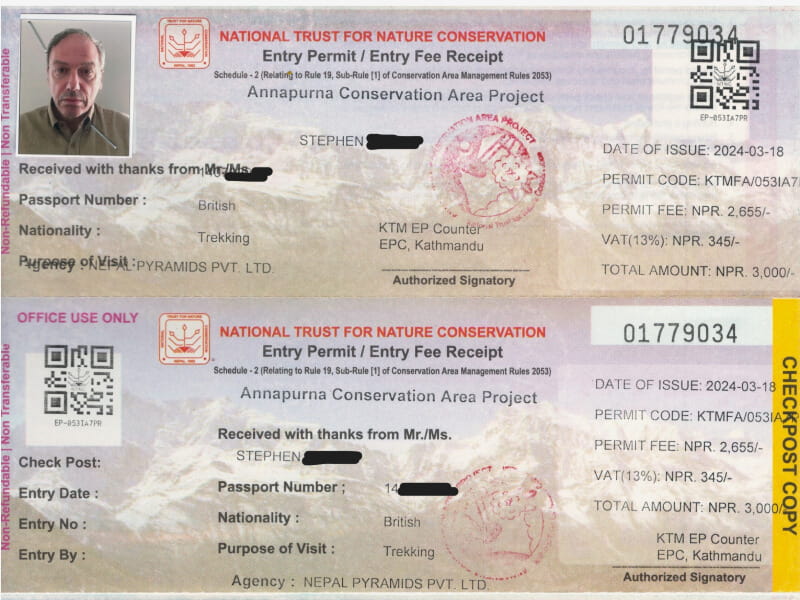
The ACAP Permit is issued by the National Trust for Nature Conservation (NTNC). The Annapurna Conservation Area is the largest protected area of Nepal, covering an area of 7,629 km² / (2,946 sq mi). The vast protected area under its conservation includes the Marsyangdi Valley, Kali Gandaki Gorge, and the high-altitude landscapes around the Thorong La pass.
- ACAP Purpose: For regional conservation, wildlife protection, and community development projects.
- Validity: Valid for the duration of your single-entry trek.
The Annapurna Conservation Area Project Permit (ACAP) is mandatory for every foreign trekker entering the Annapurna Conservation Area. The conservation area covers almost every popular trail in the region, including:
ACAP (Annapurna Conservation Area Project Permit) Cost
| Traveler Type | Cost |
| Foreign Nationals | NPR 3,000 (approx. USD 22 - 25) |
| SAARC Nationals | NPR 1,000 |
| Nepali Citizens | NPR 100 |
| Children under 10 years | Free |
This is a non-refundable single-entry fee. It covers your entire time inside the conservation area. The ACAP permit does not have a daily rate or a time limit tied to it. Travelers can trek for five days or twenty-five days inside the conservation area, and the permit will still be valid. But since it is a single-entry permit, you cannot exit the conservation area and come back with the same permit. The permit is valid until you exit, but once you exit, you will have to get a new one for re-entry.
The money goes directly to the National Trust for Nature Conservation (NTNC), which is used for trail maintenance, reforestation, waste management, community development, wildlife protection, etc.
What about the TIMS Card?
The TIMS card is the Trekking Information Management System, which was created to make trekking in Nepal safer and better organized.
It was jointly introduced by the Nepal Tourism Board (NTB) and the Trekking Agencies' Association of Nepal (TAAN). TIMS Card was designed to improve trekker safety, keep records of trekkers, discourage unauthorized trekking, and to support tourism management.
However, there are too many outdated information online that circulates and misguides travelers regarding the mandatory enforcement of the TIMS Card. This wrong information on TIMS confuses many travelers because, since the COVID-19 pandemic, the TIMS card is not enforced anywhere on the trails.
The crucial Annapurna region checkpoints at Birethanti, Ghorepani, Chhomrong, and along the Circuit now check for ACAP only. TIMS was officially required in this region until 2023, so if you see TIMS listed as mandatory for Annapurna, take it as outdated information.
But TIMS Card requirements can shift with government notice. As of now, it is important to note that TIMS is not checked on the trail.
Where and How to Get Your ACAP Permit
You have a few practical options:
- Obtain the permit in Kathmandu: At the Nepal Tourism Board permit counter, Bhrikutimandap.
- Obtain the permit in Pokhara: At the Nepal Tourism Board office, Damside. This is the most convenient option if your trek starts from Pokhara.
- Apply through a registered trekking agency: Like us, we arrange the required permit on your behalf before your trek.
- Individual online application: Through the official NTNC e-permit system. NTNC online permit link.
Documents Required
- Valid passport (or a photocopy of the passport)
- Passport-size photograph(s)
- Completed application form
- Applicable permit fee
Processing Time
ACAP permit system processing is usually quick. It takes 15 - 20 minutes if all required documents are complete. If you book through a registered agency, like us, then all required permits are issued by the agency on your behalf before you arrive in Kathmandu.
A Note on the Licensed Guide Requirement
Nepal Government has made it mandatory for all foreign trekkers trekking to the Annapurna region to trek with a licensed guide. This rule strictly applies to all trekkers regardless of whether you are on a package trip or trekking independently. Even though you have arranged permits individually, you still need to trek with a licensed guide. It is now actively and strictly checked at checkpoints alongside your ACAP permit.
Permit Cost Summary
| Trek | Permits Required | Cost (foreigners) per person |
| Annapurna Base Camp | ACAP | NPR 3,000 (USD 22 - 25) |
| Annapurna Circuit Trek | ACAP | NPR 3,000 (USD 22 - 25) |
| Ghorepani Poon Hill Trek | ACAP | NPR 3,000 (USD 22 - 25) |
| Mardi Himal Trek | ACAP | NPR 3,000 (USD 22 - 25) |
| Tilicho Lake extension | ACAP (same permit) | NPR 3,000 (USD 22 - 25) No Extra |
| Upper Mustang extension | ACAP + Restricted Area Permit | See our restricted areas guide |
| Nar Phu Valley extension | ACAP + Restricted Area Permit | See our restricted areas guide |
Frequently Asked Questions
Is ACAP the only permit I need for Annapurna Base Camp?
Yes, ACAP is the only permit required. TIMS card is not enforced on the ABC route.
Does the ACAP fee change by season?
No, the ACAP is a flat fee that stays the same all year round regardless of season or trek length.
Can I buy ACAP at the trailhead if I forget it in Kathmandu or Pokhara?
No, an ACAP permit is to be purchased before your trekking starts at the Nepal Tourism Board in Kathmandu or Pokhara.
Do I need a separate permit for Mardi Himal or Khopra Ridge?
No, both fall within the Annapurna Conservation Area and are covered by the same ACAP permit.
What if my trek crosses into Upper Mustang or Nar Phu?
For that, besides the ACAP permit, you also need to purchase a Special Permit, known as a Restricted Area Permit, which is processed through a registered trekking agency from the Nepal Immigration Office.